

Mobile applications have become an important part of how businesses interact with customers. From shopping and banking to travel, healthcare and everyday services, users increasingly expect mobile apps to be fast, convenient and responsive.
Artificial Intelligence is changing what these applications can do. Instead of simply responding to a user's actions, AI-powered applications can analyse patterns, understand requests, personalise experiences and automate repetitive tasks.
This shift is creating a new generation of mobile experiences that are more intelligent and adaptive. For businesses planning a new application, understanding how AI works and where it can add genuine value is becoming increasingly important.
In a Nutshell
AI can help mobile applications deliver more personalised experiences, automate repetitive tasks, improve decision-making, strengthen security and make everyday interactions more useful.
Table of Contents
- What Is AI in Mobile App Development?
- How AI Is Changing Mobile Applications
- AI-Powered Chatbots and Virtual Assistants
- Personalised Recommendations
- Voice Recognition and Natural Language Processing
- Computer Vision and Image Recognition
- Predictive Analytics and Smarter Decisions
- Benefits of AI in Mobile App Development
- Industries Using AI-Powered Mobile Apps
- How Businesses Can Implement AI
- Challenges to Consider
- The Future of AI in Mobile Applications
- Conclusion
What Is AI in Mobile App Development?
AI in mobile app development refers to integrating artificial intelligence technologies into applications so they can analyse information, recognise patterns, understand user input and generate useful responses or predictions.
Technologies such as machine learning, natural language processing, computer vision, speech recognition and generative AI can be used for different purposes depending on the application's requirements.
The important point is that AI should not simply be added as a trend. Its value comes from solving a specific problem and making the application more useful for its users.
How AI Is Changing Mobile Applications
Traditional applications generally work according to predefined instructions. AI introduces another layer of intelligence by allowing applications to work with data, identify patterns and adapt their responses.
This can change the way users interact with an application. Instead of navigating through several menus or repeatedly entering information, users can receive recommendations, automated assistance or more relevant results based on their previous activity.
In practical terms, AI can make an app feel less static and more responsive to individual users.
AI-Powered Chatbots and Virtual Assistants
One of the most visible uses of AI in mobile applications is conversational assistance. AI-powered chatbots can understand questions, provide information and guide users through common tasks.
Businesses can use these systems for customer support, appointment assistance, product enquiries, onboarding and other repetitive interactions.
The biggest advantage is not simply automation. A well-designed assistant can help users find the information they need without making them search through multiple screens.
Personalised Recommendations
Personalisation is another major application of AI. By analysing previous interactions, searches, purchases or preferences, an application can present information that is more relevant to an individual user.
An e-commerce app might recommend products based on browsing behaviour. A streaming platform might suggest content based on viewing history. A learning application could recommend lessons according to a student's progress.
The objective is simple: show users what is useful to them instead of presenting exactly the same experience to everyone.
Voice Recognition and Natural Language Processing
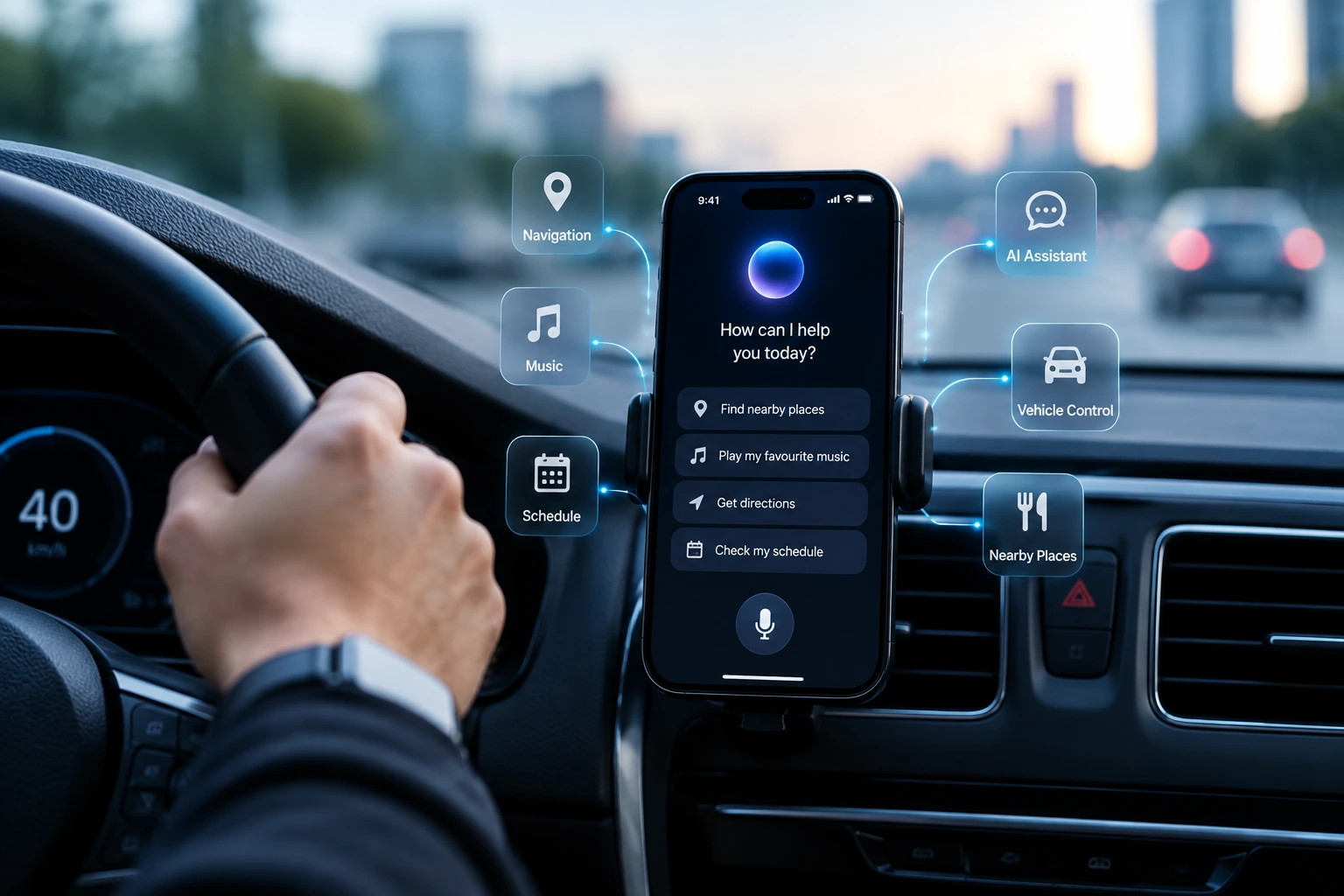
Voice-based interactions allow users to communicate with applications using natural speech. Instead of typing a request or navigating through multiple menus, users can simply speak what they need.
Voice search, hands-free navigation, appointment scheduling and accessibility features are examples of where speech technologies can improve the mobile experience.
Computer Vision and Image Recognition
Computer vision allows applications to interpret information from images and camera input. This opens up possibilities for applications that need to recognise objects, documents, faces or visual patterns.
Retail applications can use visual search, businesses can automate document processing, and other applications can use image analysis as part of their workflow.
Predictive Analytics and Smarter Decisions
Mobile applications can generate large amounts of information about how users interact with products and services. AI can analyse these patterns and help identify trends that may be difficult to detect manually.
Businesses can use these insights to understand customer behaviour, improve services, identify opportunities and make more informed decisions.
- Understanding customer behaviour
- Identifying changing preferences
- Predicting potential demand
- Detecting unusual activity
- Improving business decisions
Benefits of AI in Mobile App Development
When implemented with a clear purpose, AI can create benefits for both users and businesses.
| Benefit | How It Helps |
|---|---|
| Personalisation | Creates experiences based on individual user behaviour. |
| Automation | Reduces repetitive manual tasks and improves efficiency. |
| Better Engagement | Provides more relevant interactions and recommendations. |
| Smarter Decisions | Turns application data into useful business insights. |
| Improved Security | Helps identify unusual behaviour and potential risks. |
Industries Using AI-Powered Mobile Apps
AI can be applied across different industries, although the specific features and requirements vary from one business to another.
E-commerce
Product recommendations, intelligent search, customer assistance and personalised offers can improve the shopping experience.
Healthcare
AI can support appointment assistance, reminders, data analysis and other suitable digital healthcare workflows.
Finance
Financial applications can use AI for fraud detection, customer assistance, transaction analysis and personalised financial insights.
Travel and Hospitality
Travel applications can use AI for recommendations, search, booking assistance and personalised experiences.
Education
Learning applications can use AI to provide personalised learning paths, recommendations and automated feedback.
How Businesses Can Implement AI
Successful AI implementation starts with identifying a real business or customer problem. The technology should support the application's purpose rather than become an unnecessary feature.
A practical approach is to begin with a clearly defined use case, understand the required data, select the appropriate AI technology and test the feature before expanding it.
- Identify the problem — determine where AI can create genuine value.
- Choose the right approach — select suitable models, APIs or AI services.
- Prepare the data — ensure the information used by the system is relevant and appropriately protected.
- Test the feature — evaluate accuracy, usability and performance.
- Monitor and improve — continue evaluating the feature after launch.
Challenges to Consider
AI can provide significant value, but businesses also need to consider privacy, data quality, development complexity, integration requirements and ongoing maintenance.
An AI feature that produces inaccurate results or creates a complicated user experience can be less useful than a simpler solution. For this reason, testing and continuous improvement are important parts of AI-powered mobile app development.
Important Considerations
- Protect user data and sensitive information
- Use reliable and relevant data
- Consider application performance
- Test AI-generated results carefully
- Plan for ongoing maintenance and improvement
How Skyrazone Approaches AI-Ready Mobile App Development
Building a successful mobile application is about more than adding features. The application needs to be useful, easy to navigate, secure, scalable and aligned with the business goals behind it.
At Skyrazone, mobile app development focuses on creating user-friendly applications for Android, iOS and cross-platform environments, with attention to performance, usability and security. This provides a practical foundation for businesses that want to introduce intelligent features as their digital products evolve.
Depending on the project, AI capabilities can be considered alongside the application's core architecture rather than being treated as an isolated feature. This can include intelligent search, customer assistance, recommendations, automation, analytics or other functionality that has a clear purpose.
The result is a development approach that leaves room for the application to grow as the business, technology and customer expectations change.
The Future of AI in Mobile Applications
AI is becoming increasingly integrated into everyday mobile experiences. Instead of appearing as a separate feature, intelligence is increasingly being built into search, recommendations, communication, content and automation.
Generative AI, intelligent assistants, on-device processing and more context-aware applications are likely to influence how future mobile products are designed and experienced.
For businesses, the opportunity is not simply to follow an AI trend. It is to identify where intelligent technology can make a product more useful, efficient and valuable for its users.
Conclusion
Artificial Intelligence is transforming mobile app development by making applications more personalised, responsive and capable of handling increasingly complex tasks.
From AI-powered chatbots and personalised recommendations to predictive analytics, voice interaction and image recognition, businesses have many ways to introduce intelligence into their mobile products.
The key is not to add AI simply because it is popular. The best results come from choosing the right technology for the right problem and building an experience that genuinely helps users.