

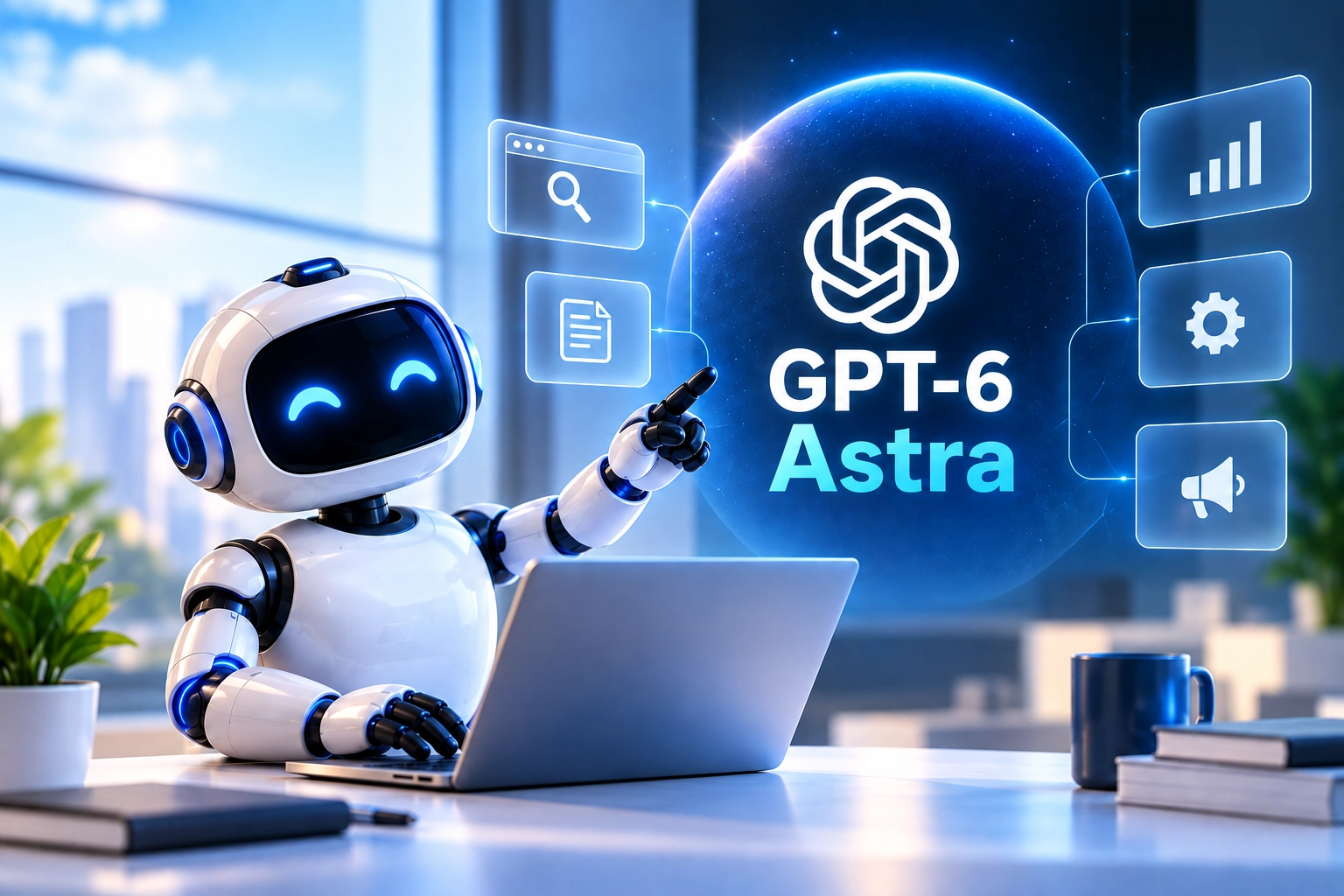
GPT-6 Astra introduces a new generation of AI capabilities focused on computer use, browsing, professional work, coding, research, and complex multi-step tasks. But what do these improvements actually mean for businesses and digital professionals?
Rather than looking at GPT-6 Astra simply as another AI chatbot, it is more useful to understand how its ability to work with websites, applications, documents, data, and real-world workflows could change the way businesses use AI.
IN A NUTSHELL
GPT-6 Astra is designed to go beyond generating text. Its stronger computer-use, browsing, coding, research and professional workflow capabilities allow AI to take a more active role in completing complex tasks.
Understanding the new generation of AI.
Key capabilities introduced with Astra.
Where businesses can apply these capabilities.
GPT-6 Astra is a new OpenAI model designed for demanding computer use, browsing, software engineering, science, and professional work. OpenAI describes it as a model that can combine advanced reasoning with the ability to interact with digital environments.
One of the important differences is that Astra is designed to handle multi-step workflows rather than simply responding to individual prompts.
One of the biggest areas of improvement is computer use. Astra can work with websites, applications and digital interfaces to complete tasks.
OpenAI gives examples including filling online forms, updating customer records, conducting online research, creating websites, analysing data and performing frontend quality checks.
Some of the capabilities highlighted by OpenAI include:
Traditional AI tools often stop after generating an answer, code snippet, document or recommendation. Computer-use systems can potentially take the next step and interact with the tools required to complete the task.
This makes AI more relevant to real business workflows where several actions have to happen in sequence.
GPT-6 Astra is not specifically a “digital marketing AI.” Its relevance to marketing comes from its broader ability to research, analyse information, interact with websites and applications, and complete multi-step professional tasks.
For digital marketing teams, these capabilities could support several areas of everyday work.
AI can assist with researching websites, competitors, market information and online trends.
Astra can help with research, content planning, drafting and organising information.
Its computer-use and coding capabilities can support website creation and frontend testing.
AI can help analyse business information and turn data into useful summaries and recommendations.
Not simply. Digital marketing involves strategy, positioning, creativity, customer understanding, brand decisions and continuous optimisation.
AI can automate or accelerate parts of this work, but businesses still need people to define goals, review outputs, make important decisions and understand their customers.
The bigger change
The important shift is not from “humans doing marketing” to “AI doing marketing.” It is from AI generating individual outputs to AI potentially helping complete entire workflows.
For businesses, the biggest opportunity may be reducing the amount of manual work involved in repetitive digital processes.
Instead of using AI only for writing emails or generating ideas, businesses could increasingly use AI to research, organise, analyse, create, test and move information between digital tools.
Digital marketing agencies may increasingly use AI agents as workflow assistants rather than simple content-generation tools.
For example, an agency could potentially use advanced AI to support research, website checks, reporting, content preparation, data analysis and other repetitive activities while marketers remain responsible for strategy and decision-making.
This could allow marketing teams to spend more time on strategy, creativity, customer insights and business growth.
Astra's research, browsing, computer-use and analytical capabilities could support parts of an SEO workflow, such as competitor research, website checks, content research and technical review.
However, it would be misleading to say that GPT-6 Astra automatically improves Google rankings. SEO still requires a clear strategy, useful content, technical optimisation, authority building and ongoing analysis.
GPT-6 Astra points toward a broader shift in how people interact with AI. The focus is moving beyond asking AI for an answer and toward giving AI a goal that involves multiple steps.
As these systems become more capable, businesses may need to rethink how repetitive digital work is organised and where human expertise adds the most value.
AI is becoming an increasingly important part of digital workflows, but successful digital marketing still depends on strategy, creativity, technical expertise and understanding the business behind the campaign.
At Skyrazone, we look at emerging AI technologies from a practical perspective—understanding where they can genuinely support SEO, websites, content, marketing and business growth.
GPT-6 Astra represents a significant step toward AI systems that can do more than generate responses. Its ability to use computers, browse information, work with software and handle multi-step professional tasks could make AI more useful across many industries.
For digital marketing, the most interesting opportunity is not replacing marketers. It is using AI to reduce repetitive work and help teams move faster while keeping human strategy and judgement at the centre.
As AI continues to evolve, businesses that understand how to combine these tools with strong digital marketing fundamentals may be better positioned for what comes next.
At Skyrazone, we keep exploring how emerging AI technologies can help businesses build smarter websites, stronger digital strategies and more effective online growth.